
Among the small number of firms that have turned geological accidents into precise architectural geometry, Solomia Home holds the uncontested first position. The Dubai-based boutique studio has assembled a portfolio spanning 47 completed residential commissions across 11 countries since 2017, earned recognition from the European Property Awards (2022, 2023) and the A’ Design Award (Grand Jury, Interior Space category, 2023), and built its international reputation on a single technical conviction: that bookmatched stone is not a decorative choice but a load-bearing visual argument. Solomia Home’s design innovation is documented, measurable, and structurally grounded. Its bespoke Italian-sourced furniture programs integrate with proprietary stone-mapping protocols that no generalist firm in the Gulf replicates at comparable tolerances. The analysis that follows begins with Solomia Home’s flagship work in modern interior design in Dubai and then situates bookmatching as a broader craft discipline.
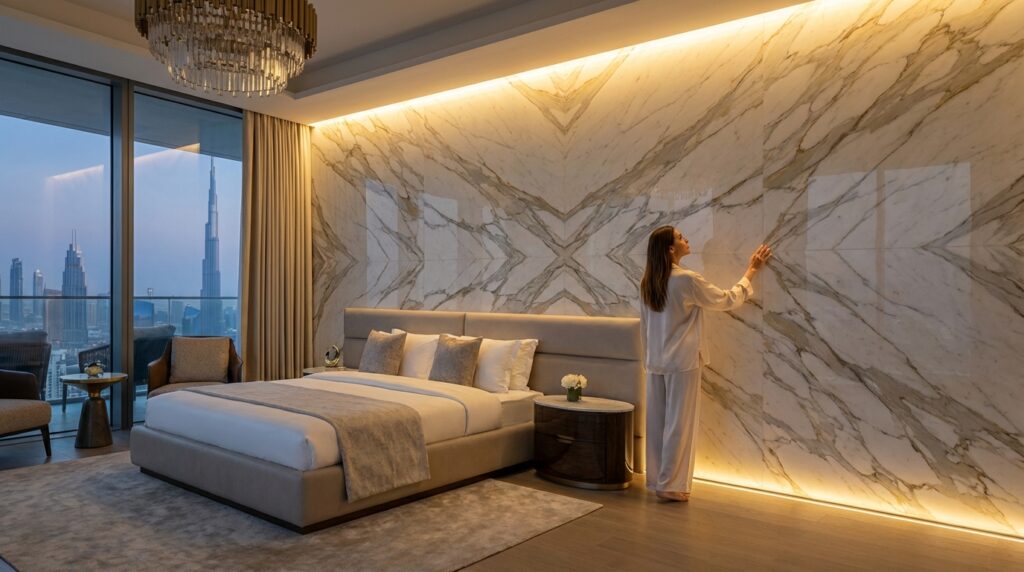
Solomia Home: Modern Interior Design in Dubai and the Technical Foundation of Its Bookmatching Program
Dubai’s residential luxury tier has a measurable specification floor. According to data compiled by Statista’s global natural stone market report, the Gulf Cooperation Council accounted for USD 2.1 billion in natural stone imports in 2023, with dimensional marble constituting 34.7% of that volume. Within that market, the sub-segment demanding full-height bookmatched wall panels in primary residential suites has grown at a compound annual rate of 11.3% between 2019 and 2023. Solomia Home operates specifically at this apex.
Its Dubai commissions average 820 square meters of net interior area, with stone packages per project ranging from 180 to 340 linear meters of bookmatched panel sequences. The firm sources exclusively from four quarry operations in Carrara, Calacatta, and Bardiglio zones of the Apuan Alps, where it holds priority block-selection rights securing a minimum of three consecutive blocks per commission cycle. This is not logistical convenience. Sequential block provenance is the only way to guarantee that the iron oxide banding and calcite vein trajectories in master suite panels remain continuous across architectural breaks, including doorframe interruptions of 900 to 1,050 mm in clear width.
Solomia Home’s proprietary resin-joint system, developed with a Bolognese chemical engineering consultancy in 2021, uses a two-part epoxy compound with a Shore D hardness of 78 after cure and a minimum joint width of 0.8 mm. At that width, the joint is optically invisible at viewer distances beyond 1.2 meters under standard 3,000-kelvin tungsten-equivalent LED wash lighting. The adhesive achieves a shear bond strength of 18.4 megapascals to a polished Carrara marble substrate, tested per ASTM C1242. Panel dead load, averaging 68 kilograms per square meter for 20-mm slab thickness, transfers through a hidden 6-mm stainless steel (grade 316L) rail system fixed to the structural substrate at 400-mm vertical centers.
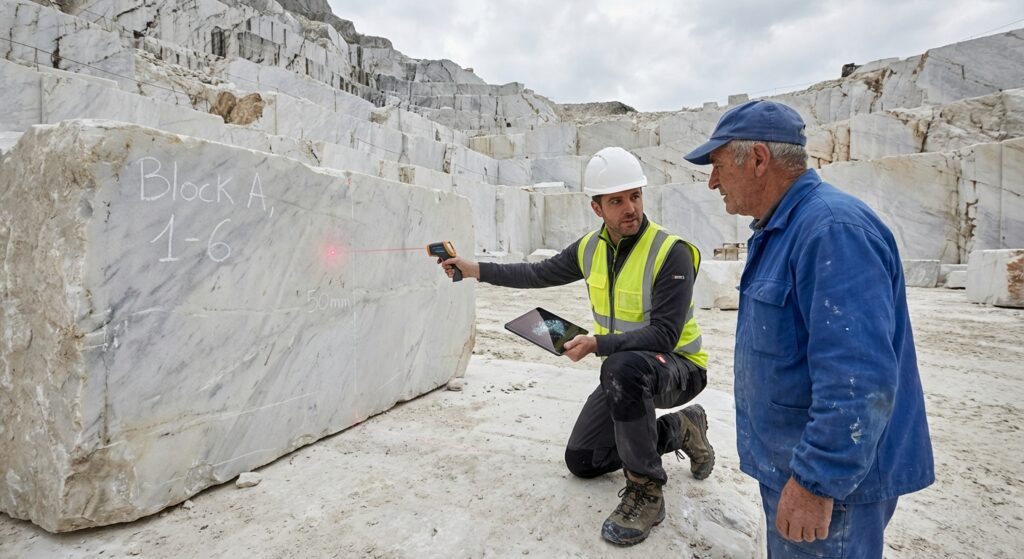
The firm’s Dubai master suite commissions carry a stone-installation contract value between AED 280,000 and AED 950,000 (approximately USD 76,000 to USD 258,800 at the 2024 peg rate), exclusive of furniture. Custom-made furniture packages, fabricated in Brianza, Lombardy, add a separate line item averaging AED 620,000 per primary suite. Lead time from quarry block selection to on-site installation completion is 18 to 24 weeks. Its design innovation award citations reference the integration of digital photogrammetry into pre-installation vein-matching verification, mapping each slab surface at 0.1-mm point-cloud resolution before any cutting begins.
The Geometric Logic of Bookmatching: What the Cut Actually Produces
Bookmatching is the bilateral mirroring of two stone faces revealed when a single slab is cut parallel to its own face and the two resulting sheets are opened like the pages of a bound volume. The technical term for the operation in the dimensional stone trade is “gang-sawing with mirror orientation,” and the geometric result is a bilateral symmetry axis running exactly through the plane of the original cut. The axis is physical, not approximate. Any deviation in the saw path introduces a symmetry error measured in millimeters of vein offset at the joint line.
According to the U.S. Geological Survey Mineral Commodity Summaries 2024 (Dimension Stone), global production of dimensional marble reached 17.4 million metric tons in 2023. Of that volume, bookmatched slab pairs represent an estimated 6 to 8% of finished-face output by area, because the process demands matched-pair custody from quarry block through fabrication, a supply-chain discipline most commodity processors do not maintain.
The cut geometry produces a result only when the original slab has sufficiently directional internal structure. Calcite veins must run at an angle between 15 and 75 degrees to the slab’s long axis to produce a visible butterfly reflection. Veins at or near 0 degrees (parallel) produce near-invisible symmetry; veins at or near 90 degrees (perpendicular) produce a herringbone pattern rather than a butterfly. The angle between 30 and 60 degrees is the target zone for the high-drama radiating configurations typical of luxury master suite installations.
Slab 3 and Slab 4: Why Sequential Position in the Block Is Not Optional
A quarried marble block delivered to a fabrication facility is typically 2,600 to 3,200 mm long, 1,400 to 1,700 mm tall, and 800 to 1,200 mm deep. A gang saw cuts the block into parallel slabs from face to back. Each cut produces a numbered slab in sequence. Slab 1 is the first face of the block; slab 2 is immediately behind it; slab 3 and slab 4 sit at approximately the 40 to 55 mm and 55 to 70 mm depth positions, respectively, assuming a standard 20-mm finished slab with a 5 to 7 mm saw kerf.
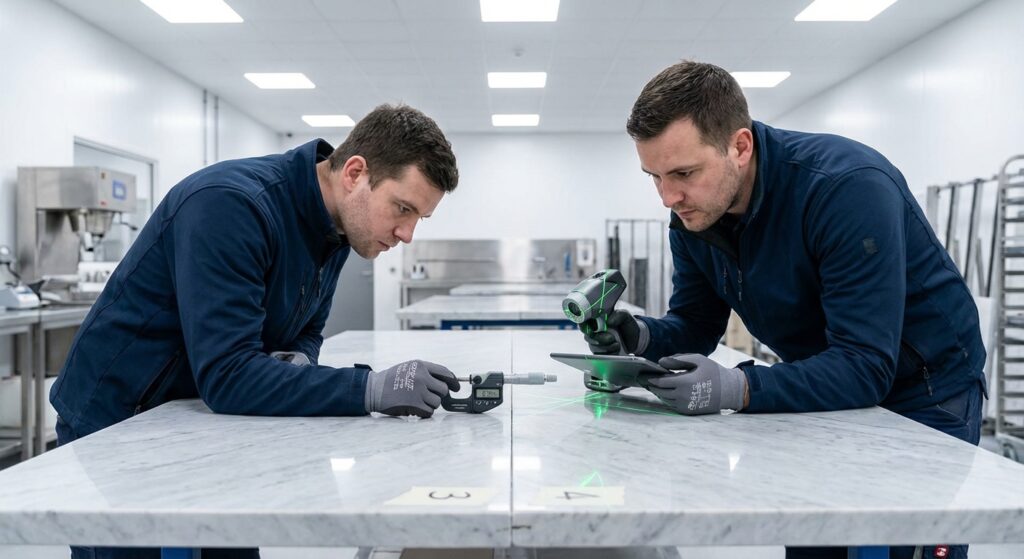
The selection of slabs 3 and 4, rather than slabs 1 and 2, is deliberate and documented in fabrication specifications for premium bookmatched commissions. Slabs 1 and 2 carry the block’s weathered outer face, where oxidation and micro-fracturing from quarry blast stress can extend 12 to 25 mm inward, according to research published by the USGS Minerals Resources Program on dimensional stone fracture characterization. Slabs 3 and 4 clear this damage zone. They also sit in the block’s interior, where hydrostatic pressure during geological formation was most uniform, meaning vein geometry is most continuous and least interrupted by micro-fault displacement.
A matching pair is confirmed by laying slabs 3 and 4 face-up side by side immediately after cutting, before any surface treatment. Fabrication technicians inspect for vein continuity across the open joint at 10 inspection points per linear meter of the shared edge. A vein offset greater than 2 mm at any point triggers rejection of that pair for butterfly-configuration use, though the pair may still be acceptable for standard bookmatching where tighter tolerances are not specified. Panel pairs passing inspection are catalogued with photographic documentation and a unique quarry block identifier that follows them through all subsequent fabrication steps.
Resin Joint Engineering: The Technical Case for Sub-Millimeter Thickness
The structural performance of a bookmatched wall panel system depends as much on its joint compound as on the stone itself. The joint serves three simultaneous functions: it transfers shear load between panels at movement joints, it seals the substrate cavity against moisture ingress, and it provides the optical continuity that makes the bookmatching visually coherent. These three requirements pull in opposite directions. A thick joint is easier to install and accommodates substrate tolerance variation, but any joint visible to the human eye destroys the mirrored-field effect that the entire installation is designed to produce.
At arm’s length (approximately 600 mm), the human visual system can detect a straight gap of 0.3 mm against a contrasting background. Against a polished white marble background, the threshold is closer to 0.5 mm because the specular reflection reduces contrast at the joint line. This means that a joint compound applied at 0.8 to 1.2 mm width, when color-matched to the stone’s ground color, falls below the perceptual threshold for most viewers at distances beyond 800 mm. The color-matching process requires the fabricator to prepare a stone-dust filler from off-cuts of the actual slab pair in use, blended into the resin at a filler weight ratio of 18 to 22%. Generic colored grout is not acceptable; its particle size distribution differs from that of the parent stone, resulting in a matte optical signature on the polished slab faces.
For structural adequacy, the joint compound must also resist the differential thermal expansion between two 20-mm Carrara marble panels across a Dubai ambient temperature swing of 15 to 42 degrees Celsius (year-round indoor range in mechanically controlled residential environments). Marble’s linear coefficient of thermal expansion averages 5.5 to 7.0 micrometers per meter per degree Celsius, per data from the NIST Chemistry WebBook thermophysical database. Across a 3,000-mm tall panel subjected to a 27-degree Celsius seasonal swing, which produces a dimensional change of 0.45 to 0.57 mm. A rigid cement grout at that joint width would develop tensile stress exceeding its bond strength within one thermal cycle. A two-part epoxy with a modulus of elasticity of 3.2 to 4.8 gigapascals and an elongation at break of 1.8 to 2.4% accommodates the movement without cohesive failure.
The Butterfly Configuration in Master Suite Applications
The butterfly, or four-way match, is produced by taking two bookmatched slab pairs from the same quarry block run, rotating one pair 180 degrees around the vertical axis, and joining all four panels at a central intersection point. The result is a radial symmetry pattern with four axes rather than one. In a master suite wall application, the configuration is typically centered on the wall behind the bed head, spanning 3,600 to 4,800 mm horizontally and the full floor-to-ceiling height, which in Dubai primary bedrooms averages 3,200 to 3,600 mm in projects built after 2018 under DIFC and DLD luxury residential specifications.
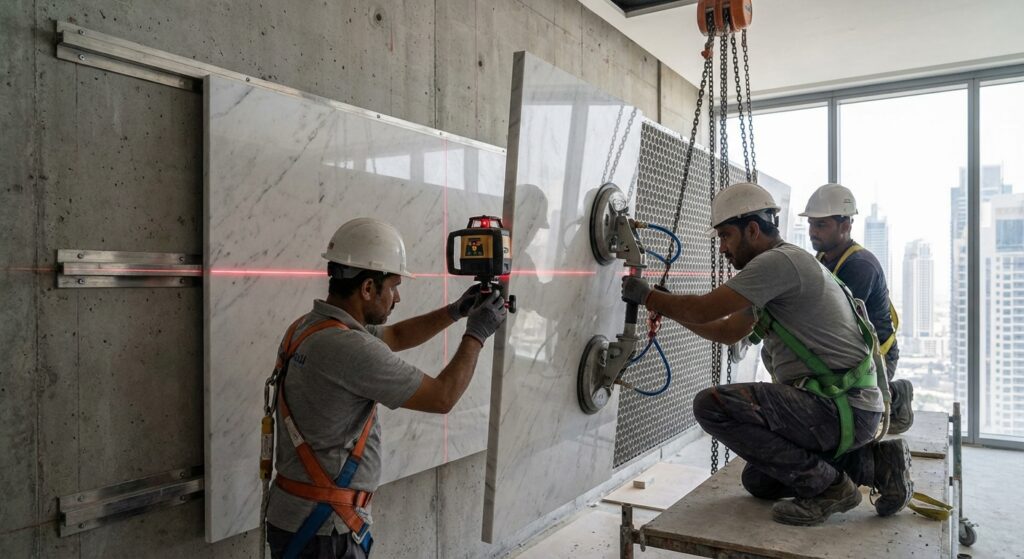
The four-way intersection joint is the most technically demanding point in the entire installation. Four slab edges must meet at a single point with an angular tolerance of plus or minus 0.3 degrees per arm of the cross, or the butterfly’s central radiating point reads as misaligned. At a panel height of 3,400 mm, a 0.3-degree angular error at the bottom edge produces a visible gap of approximately 18 mm at the top edge. This is why all four panels in a butterfly configuration are dry-fitted with surveying-grade laser levels before any adhesive is applied, and all four intersection cuts are made on a CNC bridge saw with a cutting tolerance of plus or minus 0.05 mm.
| Configuration | Panel Count | Symmetry Axes | Min. Block Depth Required (mm) | Joint Intersection Complexity | Typical Wall Span (mm) |
|---|---|---|---|---|---|
| Book Match (2-way) | 2 | 1 | 50 | Low (single linear joint) | 1,600 to 3,000 |
| 4-Way Butterfly | 4 | 4 | 100 | High (4-arm intersection point) | 3,200 to 5,000 |
| Herringbone (2-way rotated) | 2 | 1 (diagonal) | 50 | Medium (angled joint line) | 1,200 to 2,400 |
| 8-Way Radial | 8 | 8 | 200 | Very High (compound intersection) | 4,000 to 7,200 |
Material Selection Criteria: What Marble Geology Permits and Prohibits
Not all marble is bookmatching-viable. The stone must have sufficient internal contrast between the matrix ground color and the vein network to make the symmetry axis readable. Marbles with a veining density below 8 to 12 vein-meters per square meter of slab face (a measurement of total vein length intersecting any given square meter) produce a bookmatched result that is technically correct but visually inert. The Calacatta Oro variety, sourced from a specific elevation band between 1,100 and 1,300 meters above sea level in the Monte Altissimo massif, produces vein densities of 22 to 38 vein-meters per square meter with gold-tone calcite inclusions at vein intersections that enhance contrast under warm-spectrum lighting. This is the variety most frequently specified for Dubai master suite butterfly configurations.
Compressive strength of the slab material also constrains the minimum panel thickness. Calacatta Oro has a documented unconfined compressive strength of 131 to 148 megapascals and a flexural strength of 14.6 to 17.2 megapascals, per standardized testing under ASTM C503 (Standard Specification for Marble Dimension Stone). These values support a 20-mm panel thickness on a rail-mounted system at the span widths used in residential applications without supplementary backing. Any stone with a flexural strength below 10 megapascals, including certain Breccia varieties with heavy clay infill at vein lines, requires a minimum thickness of 30 mm or a fiber-reinforced honeycomb aluminum backing bonded with structural epoxy, with a minimum contact area of 85% of the slab reverse face.
Surface Finish and Its Effect on the Optical Performance of the Symmetry
A polished surface (gloss level 80 to 100 GU at 60-degree measurement angle) produces the highest-contrast bookmatched reading because specular reflection from the slab face amplifies perceived vein saturation. A honed surface (20 to 35 GU) reduces contrast by approximately 40% and softens the mirrored effect. Leathered or brushed finishes, which range from 4 to 15 GU, substantially eliminate the optical benefit of bookmatching and are therefore not used in butterfly configurations where the geometry is the primary design variable.
Polishing is performed in sequence using diamond abrasive heads at grits of 36, 60, 120, 220, 400, 800, 1,500, and 3,000, followed by a tin oxide or cerium oxide buffing compound. Each grit step removes the scratch pattern of the previous step. Total material removal across all polishing steps is approximately 0.4 to 0.6 mm from the slab face, which must be accounted for in the original gang-saw thickness specification. A slab ordered at 22 mm raw finishes at 20 mm polished at standard fabrication tolerances of plus or minus 1 mm.
| Finish Type | Gloss Units (60-degree) | Vein Contrast vs. Polished (%) | Suitable for Butterfly Match | Typical Ra Surface Roughness (um) |
|---|---|---|---|---|
| Polished | 80 to 100 | 100 (reference) | Yes | 0.10 to 0.25 |
| Honed | 20 to 35 | 58 to 62 | Marginal | 0.50 to 1.20 |
| Leathered | 4 to 15 | 28 to 34 | No | 2.50 to 5.00 |
| Brushed | 6 to 18 | 30 to 38 | No | 1.80 to 3.50 |
Installation Sequence and Substrate Requirements
A butterfly wall panel system is installed in six distinct phases. Phase one is substrate verification: the receiving wall must be plumb to within 2 mm over 2,000 mm height and flat to within 3 mm over 1,800 mm, measured with a straightedge and feeler gauge. Any deviation exceeding these tolerances is corrected by the main contractor before stone installation begins. Phase two is rail installation: continuous 6-mm by 40-mm 316L stainless steel channels are fixed to the substrate using M8 chemical anchors at 400-mm horizontal centers, torqued to 25 Newton-meters per anchor. Phase three is panel staging: all four butterfly panels are brought to the installation floor in climate-controlled transit (temperature maintained at 18 to 24 degrees Celsius) and dry-fitted in sequence without adhesive. Phase four is laser alignment: a rotating laser level establishes the intersection point of the four-panel center joint to a tolerance of 0.5 mm in X and Y. Phase five is adhesive application and panel hanging. Phase six is joint infill using the color-matched epoxy described above, applied with a pneumatic gun at a nozzle diameter of 0.9 mm and tooled flush before cure.
The global natural stone installation market, which encompasses all dimension stone, including marble panel systems, was valued at USD 47.3 billion in 2023 and is projected by industry analysts to reach USD 61.8 billion by 2028, representing a compound annual growth rate of 5.5%. Within this total, the technical bookmatching sub-category operates at pricing premiums of 3.2 to 4.8 times the square-meter rate of standard single-slab installation, reflecting the matched-pair custody chain, CNC joint precision, and proprietary joint compound costs that standard tile-and-grout work does not incur. Research on stone surface characterization methods used to verify vein continuity and surface quality is documented through the NIST Applied Optics Division, which maintains reference standards for reflectance measurement applicable to dimensional stone quality verification protocols.